The Business Research Company’s Immersive Simulator Global Market Report 2026 – Market Size, Trends, And Forecast 2026-2035
LONDON, GREATER LONDON , UNITED KINGDOM, October 26, 2026 /EINPresswire.com/ — The immersive simulator market is rapidly evolving as virtual and augmented reality technologies become integral to training and operational environments across various industries. As organizations prioritize realistic, cost-effective, and safe skill development, immersive simulators are gaining increased traction worldwide. This analysis delves into market size, regional dominance, driving factors, key players, and emerging trends shaping the immersive simulator sector.
Projected Market Size and Position within the IT Industry
The immersive simulator market is forecasted to exceed $54 billion by 2030. Within the expansive Information Technology sector, which is expected to reach $13,788 billion by the same year, immersive simulators will represent close to 0.4% of the total market value, marking their growing significance in the broader tech landscape.
Request A Free Sample Of The Immersive Simulator Market Report
https://thebusinessresearchcompany.com/sample_request?id=19576311&type=smp&name=Immersive%20Simulator%20Market%20Report%202026&utm_source=EINPresswire&utm_medium=Paid&utm_campaign=Oct_PR
North America’s Leading Role in the Immersive Simulator Market by 2030
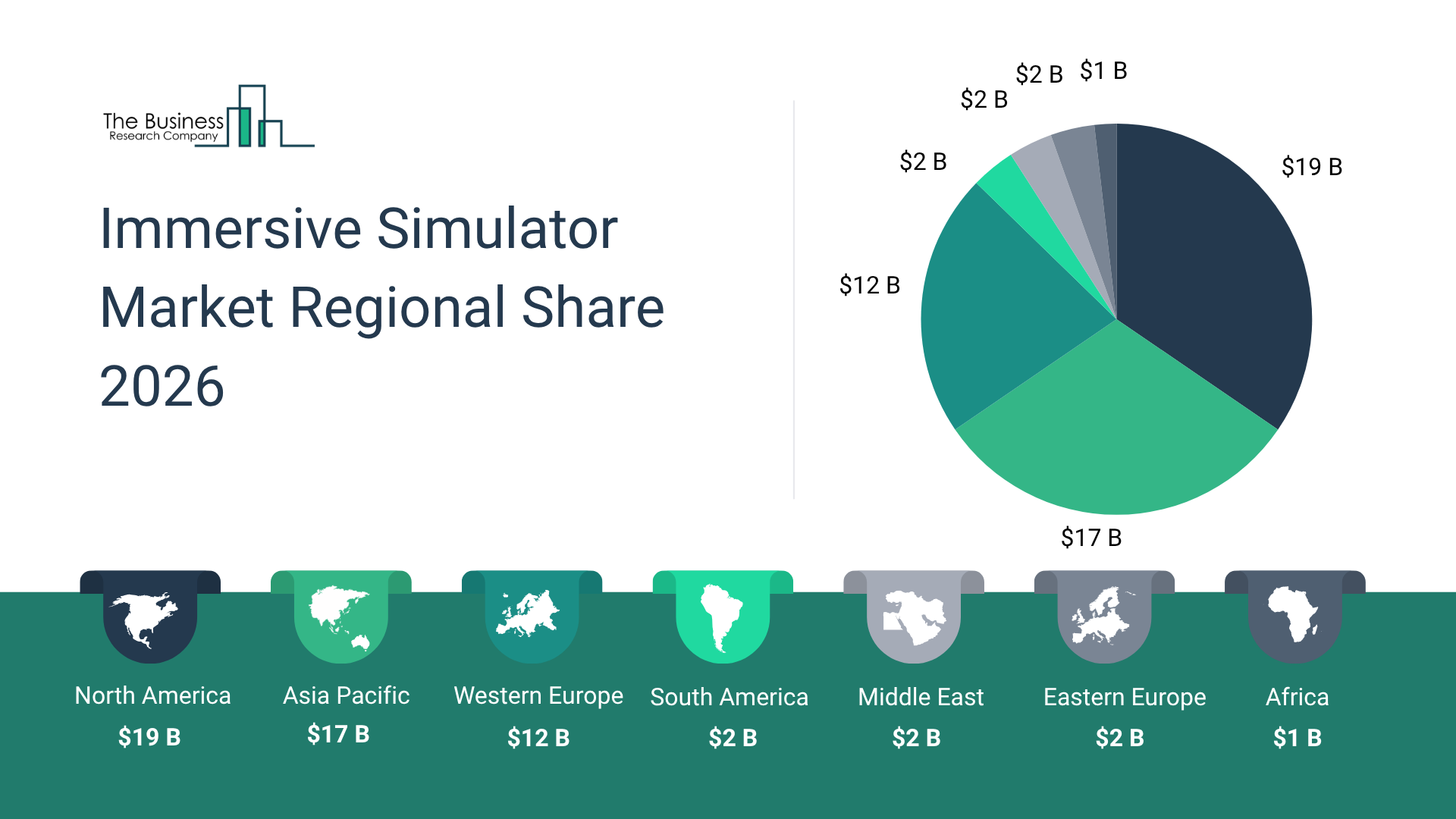
In 2030, North America is set to be the dominant region in the immersive simulator space, with a market value projected at $18.9 billion. From $6.3 billion in 2025, the market is anticipated to expand at a robust compound annual growth rate (CAGR) of 25%. This surge is driven by widespread adoption of virtual reality (VR) and augmented reality (AR) simulation across sectors such as defense, healthcare, education, and industrial training. Additional factors include the increasing need for risk-free skill development platforms, substantial investments in advanced simulation technologies, growing aerospace and automotive training use cases, a heightened focus on workforce readiness, and a strong concentration of technology innovators in the United States and Canada.
The United States as the Largest National Market for Immersive Simulators
The USA is projected to hold the largest share within the global immersive simulator market by 2030, valued at $16.8 billion. It is expected to grow from $5.6 billion in 2025 at a CAGR of 25%. Key growth drivers include the expanded adoption of immersive simulation platforms for military and aviation training, increased use of virtual training in emergency response and public safety, rising demand for authentic simulation-based educational experiences, growth in enterprise training initiatives, technological advancements in haptic feedback and 3D visualization, and sustained investments by technology providers to develop next-generation platforms.
Access The Detailed Immersive Simulator Market Report Here
https://thebusinessresearchcompany.com/report/immersive-simulator-global-market-report?utm_source=EINPresswire&utm_medium=Paid&utm_campaign=Oct_PR
Dominance of Console Operator Training Segment in Market Share
Among the market segments categorized by type, console operator training will be the largest, accounting for 59%, or $32 billion, of the total immersive simulator market value in 2030. This segment benefits from growing demand for sophisticated control room simulations, virtual training for complex operational scenarios, the need to reduce human errors in critical tasks, real-time data integration improvements, and expanding use cases across energy, transportation, and industrial sectors. The focus on enhancing operator decision-making and preparedness further supports the segment’s strong growth.
Overview of Market Segmentation by Offering and Application
The immersive simulator market is categorized by offerings into hardware, software, and services. Application-wise, it spans various industries including oil and gas, chemicals, power energy, metals mining, medical biotech, aerospace and defense, automotive marine, and other sectors. This diverse portfolio underscores the wide-ranging applicability of immersive simulation technologies across critical areas of the global economy.
Forecasted Growth Rate for Immersive Simulators Through 2030
A compound annual growth rate of 25% is expected for the immersive simulator market leading up to 2030. This reflects robust expansion driven by technological adoption and increasing use cases in training and operational simulations.
Major Factors Propelling Growth in the Immersive Simulator Market
One of the primary growth engines for immersive simulators is the surging adoption of VR and AR technologies across industries. Organizations are leveraging these technologies to create interactive, realistic, and risk-free simulation environments for training, design, maintenance, and operational planning. Sectors such as healthcare, aerospace, defense, manufacturing, automotive, education, and entertainment are utilizing immersive simulation to boost workforce efficiency, improve learning outcomes, cut operational errors, and reduce training expenses. Advances in hardware affordability, real-time rendering, AI integration, and cloud connectivity are accelerating this trend, contributing an estimated 2.7% annual market growth.
Increasing demand for simulation-based training and immersive learning solutions also fuels market expansion. Businesses across healthcare, aviation, defense, manufacturing, and education embrace virtual training environments to enhance employee skills, improve safety, and lower operational risks. These solutions offer realistic hands-on experiences without the expenses or dangers of traditional training, improving knowledge retention, accelerating skill acquisition, and enabling scalable remote learning. This factor is anticipated to add around 2.5% growth annually to the market.
Greater accessibility of immersive hardware is another key driver. The decreasing cost of VR headsets, AR devices, motion sensors, and haptic technology makes immersive experiences more affordable and widely available. Improvements in hardware performance, portability, and user comfort support adoption in healthcare, education, manufacturing, gaming, and defense sectors. Enhanced connectivity, cloud integration, and compatibility with advanced software platforms further increase the scalability and effectiveness of these solutions. This trend is expected to contribute approximately 2.2% annual growth to the immersive simulator market.
Emerging Growth Opportunities in Training Segments by 2030
The console operator training and field operator training markets represent significant growth prospects, collectively expected to exceed $37 billion by 2030. These segments are expanding due to rising demand for immersive workforce training, simulation-based certification programs, safer training environments in high-risk industries, and advances in VR hardware and interactive simulation platforms. Their application is broadening across defense, healthcare, utilities, and manufacturing, with a growing emphasis on improving workforce competency, reducing operational risks, and enhancing training effectiveness through cutting-edge simulation technologies.
Market Dynamics and Competitive Landscape Overview
From 2025 to 2030, the console operator training segment is projected to grow by $22 billion, while the field operator training segment will expand by $15 billion. The immersive simulator market is characterized by a mix of global technology providers and niche virtual training developers. Leading companies focus on advanced VR systems, real-time simulations, interactive environments, and sophisticated visualization tools to provide realistic learning and operational experiences. Core competitive strategies revolve around immersive training solutions, skill development improvements, and integration of AI, haptic feedback, and digital simulation platforms. Navigating this competitive landscape is crucial for stakeholders aiming to capitalize on market growth and innovation.
Top Company Leading Sales in the Immersive Simulator Market
Research indicates that Microsoft Corporation was the global sales leader in 2025 with a 1% market share. Its mixed reality and simulation technology division offers a comprehensive range of immersive platforms, VR solutions, simulation tools, and digital experience technologies supporting training, education, enterprise uses, and interactive virtual applications.
Key Industry Players in the Immersive Simulator Market
Major companies active in this market include Microsoft Corporation, NVIDIA Corporation, Epic Games Inc., Unity Software Inc., Saab AB, Siemens AG, Dassault Systèmes SE, Indra Sistemas, Qualcomm Incorporated, AVEVA Group plc, 3D Systems Corporation, Magic Leap Inc., Pimax Technology (Shanghai) Co. Ltd., EON Reality Inc., Immersive Technologies Pty Ltd., Mass Virtual Inc., Strivr Labs Inc., Varjo Technologies Oy, VirtaMed AG, Simul8 Corporation, Wikitude GmbH, Immerse Learning Ltd., and Designing Digitally Inc.
Market Fragmentation and Competitive Concentration
The immersive simulator market is relatively fragmented, with the top 10 companies accounting for only 4% of total revenue in 2025. This indicates moderate barriers to entry driven by ongoing technological innovation, software development capabilities, hardware integration demands, and the necessity for reliable, realistic training environments. Leading firms such as Microsoft Corporation, NVIDIA Corporation, Epic Games Inc., Unity Software Inc., Saab AB, Siemens AG, Dassault Systèmes SE, Indra Sistemas, Qualcomm Incorporated, and AVEVA Group plc hold significant market shares, supported by diversified offerings, strong tech partnerships, global customer bases, and continuous innovation. As demand for advanced simulators, virtual environments, extended reality solutions, and digital twin technology rises, strategic collaborations and regional expansion will bolster their market positions.
Notable Raw Material Suppliers Powering the Immersive Simulator Market
Key suppliers of raw materials and components include NVIDIA Corporation, Intel Corporation, Advanced Micro Devices Inc., Qualcomm Incorporated, Sony Semiconductor Solutions Corporation, Samsung Electronics Co. Ltd., LG Display Co. Ltd., BOE Technology Group Co. Ltd., Panasonic Holdings Corporation, Canon Inc., Epson Corporation, Texas Instruments Incorporated, STMicroelectronics N.V., Infineon Technologies AG, NXP Semiconductors N.V., Analog Devices Inc., Microchip Technology Incorporated, Broadcom Inc., Murata Manufacturing Co. Ltd., Omron Corporation, Bosch Sensortec GmbH, TE Connectivity Ltd., Corning Incorporated, Seagate Technology Holdings plc, and Western Digital Corporation.
Major Wholesalers and Distributors Supporting Market Reach
Prominent wholesalers and distributors serving the immersive simulator industry include Arrow Electronics Inc., Avnet Inc., Digi-Key Electronics, Mouser Electronics Inc., Future Electronics Inc., TTI Inc., RS Group plc, Newark Electronics, Farnell, Allied Electronics & Automation, Ingram Micro Inc., Tech Data Corporation, TD SYNNEX Corporation, ScanSource Inc., CDW Corporation, Insight Enterprises Inc., Bechtle AG, ALSO Holding AG, Esprinet S.p.A., Redington Limited, Exclusive Networks SA, Westcon Group, Mindware FZ LLC, ASBIS Enterprises PLC, and EET Group A/S.
Primary End Users of Immersive Simulator Technologies
The main end users of immersive simulation solutions include Meta Platforms Inc., Apple Inc., Microsoft Corporation, Alphabet Inc., Amazon.com Inc., HTC Corporation, Valve Corporation, Unity Technologies Inc., Epic Games Inc., Autodesk Inc., Dassault Systèmes SE, Siemens Digital Industries Software, Lockheed Martin Corporation, Boeing Company, Airbus SE, CAE Inc., L3Harris Technologies Inc., Thales Group, BAE Systems plc, Honeywell International Inc., Rockwell Automation Inc., PTC Inc., Varjo Technologies Oy, and EON Reality Inc.
How AI Is Shaping Trends in the Immersive Simulator Market
Artificial intelligence-powered immersive simulators are revolutionizing this market by enhancing realism, improving training outcomes, and enabling interactive skill development across diverse sectors. For example, in August 2024, EON Reality introduced an AI skill simulator—an augmented reality-based platform designed for AI-driven skill development and performance evaluation. This platform employs AI-generated avatars, virtual practice environments, and real-time feedback to boost learning efficiency, workplace safety, and personalized training experiences.
Strategies Adopted by Companies to Maintain Market Leadership
Leading companies in the immersive simulator field are pursuing strategies focused on advancing simulation technologies to create more immersive experiences and effective learning environments. They are leveraging VR and AR solutions to enhance training precision, broadening simulator applications to improve outcomes, and integrating AI simulation platforms that allow for greater personalization and informed decision-making.
Our 2026 reports feature deeper market intelligence with market attractiveness scoring and analysis, total addressable market (TAM) analysis, company scoring matrix graphics and tables, Excel-based forecasting dashboards, market hotspots infographics, key technologies and future trend analysis, and updated graphics and tables.
Learn More About The Business Research Company
The Business Research Company (www.thebusinessresearchcompany.com) is a leading market intelligence firm renowned for its expertise in company, market, and consumer research. We have published over 30,000+ reports across 27 industries and 60+ geographies. Our research is powered by 1,500,000 datasets, extensive secondary research, and exclusive insights from interviews with industry leaders.
We provide continuous and custom research services, offering a range of specialized packages tailored to your needs, including Market Entry Research Package, Competitor Tracking Package, Supplier & Distributor Package and much more.
Disclaimer: Please note that the findings, conclusions and recommendations that TBRC Business Research Pvt Ltd delivers are based on information gathered in good faith from both primary and secondary sources, whose accuracy we are not always in a position to guarantee. As such TBRC Business Research Pvt Ltd can accept no liability whatever for actions taken based on any information that may subsequently prove to be incorrect. Analysis and findings included in TBRC reports and presentations are our estimates, opinions and are not intended as statements of fact or investment guidance.
Contact Us:
The Business Research Company
Americas +1 310-496-7795
Europe +44 7882 955267
Asia & Others +44 7882 955267 & +91 8897263534
Email: marketing@tbrc.info
Follow Us On:
LinkedIn: https://in.linkedin.com/company/the-business-research-company.
Oliver Guirdham
The Business Research Company
+44 7882 955267
info@tbrc.info
Visit us on social media:
LinkedIn
Facebook
X
Legal Disclaimer:
EIN Presswire provides this news content “as is” without warranty of any kind. We do not accept any responsibility or liability
for the accuracy, content, images, videos, licenses, completeness, legality, or reliability of the information contained in this
article. If you have any complaints or copyright issues related to this article, kindly contact the author above.

Media gallery