
Organizations with trustworthy AI practices are 15 times more likely to see strong ROI, per study findings
PR Newswire
CARY, N.C., Sept. 1, 2026
Employees override AI they don’t understand, and it’s challenging organizations seeking AI return
- The number one reason employees override AI in the field? When AI can’t explain a decision it’s made.
- Most organizations still lack the data foundation needed to make AI trustworthy and profitable.
CARY, N.C., Sept. 1, 2026 /PRNewswire/ — A new SAS report with research insights by IDC uncovers what’s powering the organizations winning the race to profit from their AI investments: embracing trustworthy AI measures. Organizations applying trustworthy AI practices were 15 times more likely to report strong return on investment (ROI) from their AI projects.
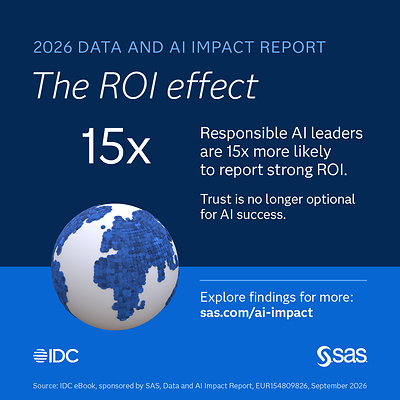
As identified in the second annual Data and AI Impact Report: The New Economics of Trust, organizations with the strongest governance, data quality and auditability practices – a comparatively small market segment – consistently outperformed peers, reporting at least double the ROI from AI deployments. Fewer than one in 20 trustworthy AI ‘laggard’ organizations reported the same.
“When AI works, it’s incredibly impactful,” said Bryan Harris, CTO at SAS. “However, it is well documented that state-of-the-art agents can have error rates that exceed 25% on complex tasks1 – which is unacceptable in high-stakes decision-making. In order to achieve accuracy and repeatability, organizations must embed domain expertise into agentic workflows, while keeping people at the center of governance and oversight. Organizations that do this successfully will close the trust gap and gain a competitive advantage in the market with AI.”
“As AI becomes more autonomous, organizations face a new challenge: maintaining confidence in systems people don’t fully understand,” said Chris Marshall, Vice President at IDC. “Our findings show that stronger oversight, explainability, accountability and data foundations are becoming prerequisites for scaling AI successfully.”
The report’s findings span three themes:
AI that can’t explain itself is a major business liability
Researchers found that at many organizations, employees are increasingly hesitant to rely on systems that may or may not be able to offer correct output or explain how AI arrived at a final decision. As AI gains autonomy, this liability grows, making explainability crucial for success.
The report also explored a major hurdle to success in AI adoption: when employees’ lack of trust in AI decisions leads them to override and make manual corrections. This only perpetuates the AI trustworthiness deficit, and can cost organizations time, productivity and profitability. When AI decision-making is only as good as the data it’s based on, building a strong data foundation becomes pivotal for organizations looking to reduce override rates.
Key findings:
- 97.2% of users override AI-generated recommendations in at least some cases.
- The number one reason employees decided to override AI, regardless of whether its output was considered correct, was when the AI could not provide an explanation behind its decision.
- Trust falls from 76% for generative AI to 66% for agentic AI, highlighting growing concerns as AI systems gain more autonomy.
Trustworthy AI practices drive business success
The report exposes a widening ROI divide between organizations that prioritize trustworthy AI practices and those that do not. The findings suggest organizations gaining the most value from AI are not necessarily deploying different technologies but instead managing AI differently.
Key findings:
- Organizations investing in trustworthy AI measures are 15 times more likely to report strong or high ROI on their AI projects (62% vs. 4%).
- Organizations with the strongest trustworthy AI practices realize 1.85 times greater gains across 13 different business outcomes, including revenue growth, cost savings and customer experience.
- 85% of these AI leaders with trustworthy practices are increasing their investment in this area by more than 10% this year, actively widening the performance gap.
Too many organizations are losing time and money to weak data foundations
Most organizations are deploying AI on severely underdeveloped or outdated data and data infrastructure. Without a strong data foundation to support crucial transparency and explainability, organizations struggle to govern AI effectively and realize value.
Key findings:
- Only 17.5% of enterprises have a fully optimized data infrastructure mature enough for the demands of agentic AI, which negatively impacts performance.
- Organizations with an optimized data foundation are four times more likely to expect strong ROI from AI projects, and six times more likely to mandate the data quality and explainability controls necessary to build trust.
Take a deeper dive
The findings are based on a global survey of 2,699 decision-makers with knowledge of or influence over their company’s data and AI initiatives. The survey was conducted across 28 countries and four focus industries: banking, insurance, life sciences and the public sector. The report highlights industry use cases and findings that demonstrate how leaders in each of these industries around the globe are approaching AI.
Key findings:
- Banking leaders are going beyond compliance, treating robust AI governance as a competitive advantage and operational necessity – 85% of AI leader banks have established governance frameworks, compared to just 29% of laggards.
- Forty-one percent of public sector leaders are increasing trustworthy AI investment by more than 20% in the year ahead, which is as fast as the most ambitious organizations across any industry.
- 23% of life sciences organizations have scaled AI company-wide – the highest of any industry.
Explore study findings and access the full report at sas.com/ai-impact.
What makes AI trustworthy?
Trustworthy AI is artificial intelligence designed to be reliable, fair, secure, up to regulatory standards, and able to clearly show how it arrived at a decision. Users and decision-makers at all levels within an organization must be able to hold an AI system to a pre-determined chain of accountability for incorrect or missing AI output. Any AI system must also be governed and proven to be in compliance with clear rules.
What makes an organization a trustworthy AI leader?
Within the study, organizations were scored out of 100 against five dimensions of trustworthy AI. The report’s trustworthy AI leaders were organizations with an average total score of 80 or higher.
Each organization was scored across the following five trustworthy AI criteria.
- Data quality and governance.
- Model governance and oversight.
- Explainability and fairness.
- Responsible AI policy.
- Audit and accountability.
About SAS
SAS is a global leader in data and AI, helping organizations make confident decisions with AI they can trust. For decades, SAS has set the standard for delivering software that drives meaningful impact, incorporating deep industry expertise, transparency and governance. SAS gives you THE POWER TO KNOW®.
SAS and all other SAS Institute Inc. product or service names are registered trademarks or trademarks of SAS Institute Inc. in the USA and other countries. ® indicates USA registration. Other brand and product names are trademarks of their respective companies. Copyright © 2026 SAS Institute Inc. All rights reserved.
Editorial Contacts:
Jennifer James, SAS
jennifer.james@sas.com
Julia Norton, SAS
julia.norton@sas.com
1 Sources: Stanford HAI, 2026 AI Index Report; independent AI agent benchmark evaluations.
 View original content to download multimedia:https://www.prnewswire.com/news-releases/organizations-with-trustworthy-ai-practices-are-15-times-more-likely-to-see-strong-roi-per-study-findings-302865784.html
SOURCE SAS


