In two analyses, Noom members were modeled to gain less than 2% of bodyweight up to 12 months after stopping medication — with the strongest maintenance among those who continued practicing healthy habits
- Noom members regained 3x less of their lost weight at 12 months than published post-discontinuation benchmarks (21.2% vs. 61.4%)
- Modeled estimates suggest members gained only 1.1% and 0.4% body weight at 12 months after stopping
- Members who continued practicing more Noom habits gained about 50% less weight per month than members who practiced fewer habits
PRINCETON, N.J., June 24, 2026 (GLOBE NEWSWIRE) — Noom, the leading behavior change company, today announced new observational analyses suggesting that members who used Noom’s GLP-1-supported programs maintained most of their weight loss after discontinuing GLP-1 medication.
Across two smaller-sample analyses of Noom members who lost at least 5% of their body weight while enrolled in GLP-1-supported programs, members lost roughly 14% of body weight before stopping medication. After discontinuation, modeled estimates suggest average weight gain remained low for up to 12 months: 1.1% body weight in one sample and 0.4% in the other.
The analyses also found that Noom members showed substantially lower modeled weight regain than published post-discontinuation benchmarks. At 12 months, Noom members were estimated to regain 21.2% of the weight they had lost, compared with 61.4% in published benchmarks — approximately threefold lower modeled regain.
“The biggest question in obesity care today is what happens when people stop GLP-1s,” said Dr. Erin Owen, Head of Research at Noom. “Our early data point to one clear signal: the members who keep practicing healthy habits hold onto the most weight loss. Habits are what last.”
“GLP-1s are a powerful catalyst, but the future of weight management can’t be medication alone, not so long as discontinuation rates remain so high,” said Geoff Cook, CEO of Noom. “Noom is the behavior layer that empowers lasting change.”
Why This Matters Now
GLP-1 medications have transformed weight loss care, helping many people reduce hunger, quiet cravings, and achieve meaningful weight loss. But discontinuation is common: Nearly one in five U.S. adults say they have taken a GLP-1, and about a third of them have already stopped. Real-world data also suggest that most people discontinue GLP-1 therapy within the first year of treatment.
Once medication stops, weight regain is common. A 2026 meta-analysis found that people regained about 60% of the weight they lost within one year after GLP-1 cessation, with regain plateauing near 75% beyond one year. The challenge is not willpower; obesity is a chronic biological condition, and appetite, hunger, and weight-regulation systems may shift after medication ends.
Noom’s new analyses point to a more hopeful possibility: GLP-1s may help create an opening for weight loss, and habit support may help people maintain more of that progress over time.
Inside the Analyses
Noom analyzed two groups of members who used GLP-1-supported Noom programs, lost at least 5% of their body weight while enrolled, and later discontinued medication. Members reported their current weight and continued habit use after stopping, and Noom modeled weight change at 6 and 12 months after discontinuation.
The first sample included 141 members from Noom’s GLP-1Rx Program. Members in this sample had lost an average of 14.3% of their body weight by the time they stopped medication. The second sample included 51 members from Noom’s Telehealth for Branded Meds program. Members in this sample had lost an average of 13.8% of their body weight by the time they stopped medication.
Key findings:
- Weight maintenance after stopping: Modeled estimates suggest members gained less than 2% body weight during the first year after stopping: 1.1% in one sample and 0.4% in the other.
- Comparison with published benchmarks: At 12 months, Noom members were estimated to regain 21.2% of lost weight, compared with 61.4% in published post-discontinuation benchmarks.
- Habit persistence: Members who continued practicing more Noom habits after stopping regained about 50% less weight per month than members who practiced fewer habits.
- Engagement and durability: Members who were highly engaged with Noom during the program were 2.4x more likely than less-engaged members to report still using Noom habits after discontinuation.
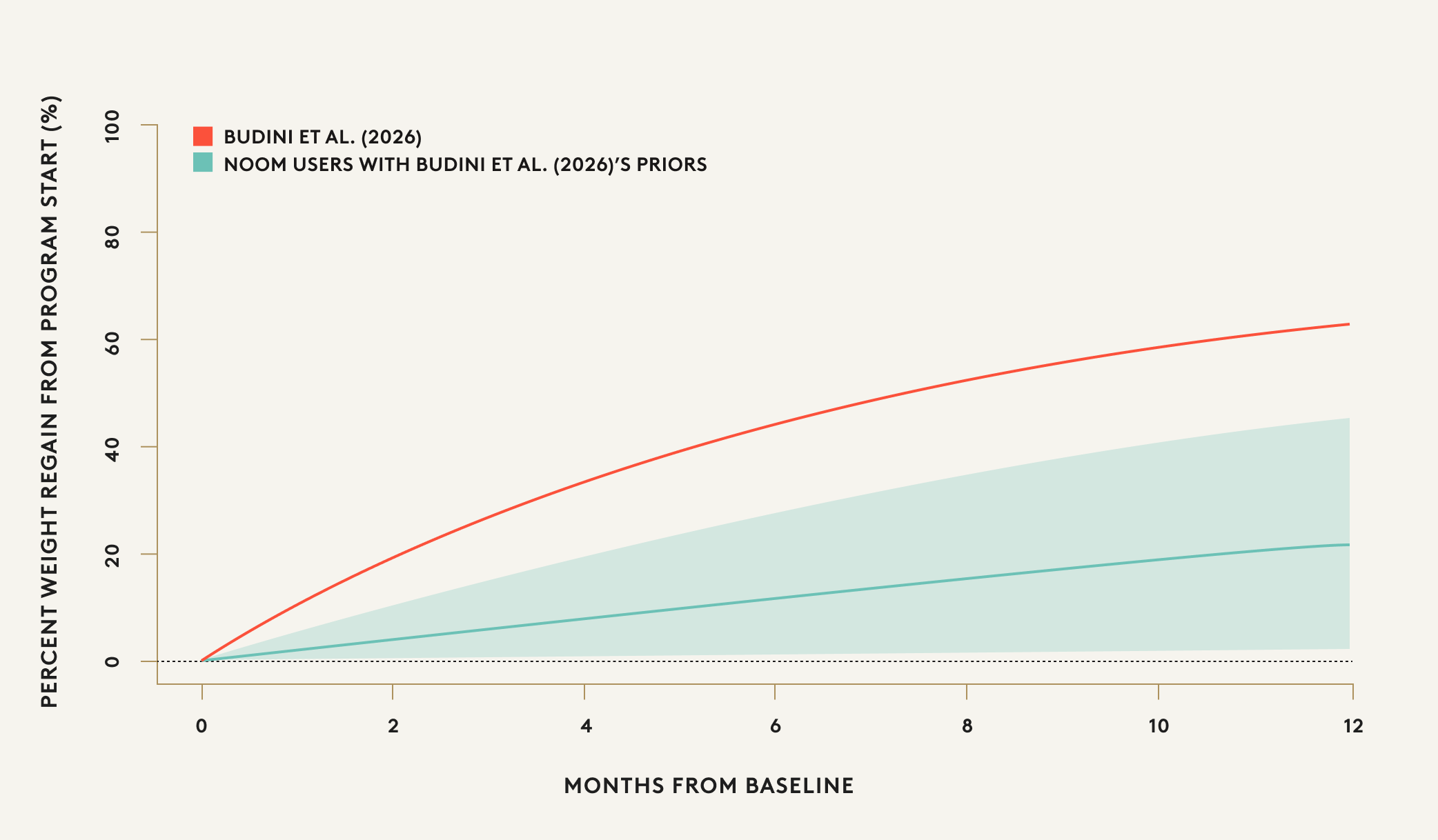
At 12 months after discontinuation, Noom members showed roughly threefold lower modeled regain of lost weight than published post-discontinuation benchmarks.
Behavior Change for the GLP-1 Off-Ramp
The analyses support a central idea for the next phase of obesity care: durable outcomes depend not only on what happens while people are taking medication, but on what they build around it. GLP-1s can reduce hunger and cravings, creating a window when it may be easier to build new routines around nutrition, movement, sleep, stress management, and self-monitoring.
Noom’s GLP-1 Companion and related programs are designed to support those routines with behavior change tools, self-monitoring, coaching, and daily skill-building. In these analyses, members who kept practicing more Noom habits after discontinuation appeared to maintain more of their weight loss.
The findings are preliminary and observational, not proof of causality. But they add to a growing body of evidence that behavior support may be a critical layer of modern weight management — used alongside medication, after medication, or as part of a broader metabolic health strategy.
About the Data
These findings reflect observational analyses of Noom member samples and report modeled weight change after GLP-1 discontinuation among members in these samples only. The analyses are not randomized controlled trials. Some outcomes were self-reported, sample sizes were relatively small, and comparisons with published benchmarks are informative but not the same as a head-to-head control group. Individual results vary. GLP-1 medications should be used under the guidance of a qualified healthcare provider.
Methodology: The results draw on three complementary analyses conducted by Noom’s research team. Study 1 was a retrospective survey of former Noom GLP-1Rx members: of 2,070 members invited, 311 responded (a roughly 15% response rate), and 141 met inclusion criteria — at least four months in the program, at least 5% weight loss while enrolled, and no GLP-1 restart. Study 2 was a prospective study representative of Noom’s Telehealth for Branded Meds program, in which 171 of 3,204 invited members responded (about a 5% response rate) and 51 met inclusion criteria, with follow-up surveys at 3, 6, 9, and 12 months after discontinuation. Study 2 used results from Study 1 as prior information to inform estimates. Study 3 benchmarked Noom outcomes against a 2026 systematic review and meta-regression of six randomized GLP-1 trials (Budini et al., 2026; 3,236 participants), using the results from Budini et al., 2026 article as prior information. Weight change was estimated using Bayesian latent growth-curve models with 95% credible intervals reported; estimates beyond roughly four months carry wider intervals and greater uncertainty.
Study limitations: These analyses were observational and based on Noom member samples, not randomized controlled trials. Weight and habit data included self-reported follow-up survey responses. Sample sizes were relatively small, and true values may vary. Comparisons with published benchmarks may differ in study design, population, medication type, treatment duration, baseline BMI, clinical support, and other factors. Respondents self-selected rather than being randomly sampled, and follow-up sample sizes shrank over time, which may bias results toward more successful maintainers. The prospective sample was predominantly White, limiting generalizability, and 12-month estimates carry wide credible intervals that warrant caution. As with any Bayesian analysis, results depend on the modeling assumptions and prior information used.
About Noom
Noom is the leading behavior change company, empowering everyone, everywhere to live better longer – every day. Noom pairs sustainable behavior change with prescription-grade catalysts to make lasting change feel easy. Noom Health partners with top health plans and employers to offer millions of Americans a suite of metabolic health solutions – including Noom Med, Noom Weight, Noom Diabetes, and Noom Diabetes Prevention Program. Noom is building the future of preventive care and longevity medicine, leading the convergence of wearable-monitored behavior change, clinical care, diagnostics, and pharmacy into an integrated, AI-enhanced system that drives individualized, meaningful health outcomes.
Noom has received multiple grants from the NIH for digital health research and innovation and has been recognized by the CDC for its groundbreaking diabetes prevention programs. With offices in New York City and Princeton, NJ, Noom has been recognized as a TIME100 Industry Leader, on Newsweek’s Most Trusted Brands list, as well as by Inc. and Fortune as a best place to work. Learn more at noom.com, subscribe to our blog, or follow us on Twitter and LinkedIn.
Note to editors: A high-resolution version of the chart, additional data, and interviews with Noom research and clinical leaders are available on request.
Press Contact:
Daniel Zahler
comms@noom.com
A photo accompanying this announcement is available at https://www.globenewswire.com/NewsRoom/AttachmentNg/93067e89-b4a8-4cef-b4c1-95285ce7bc5e