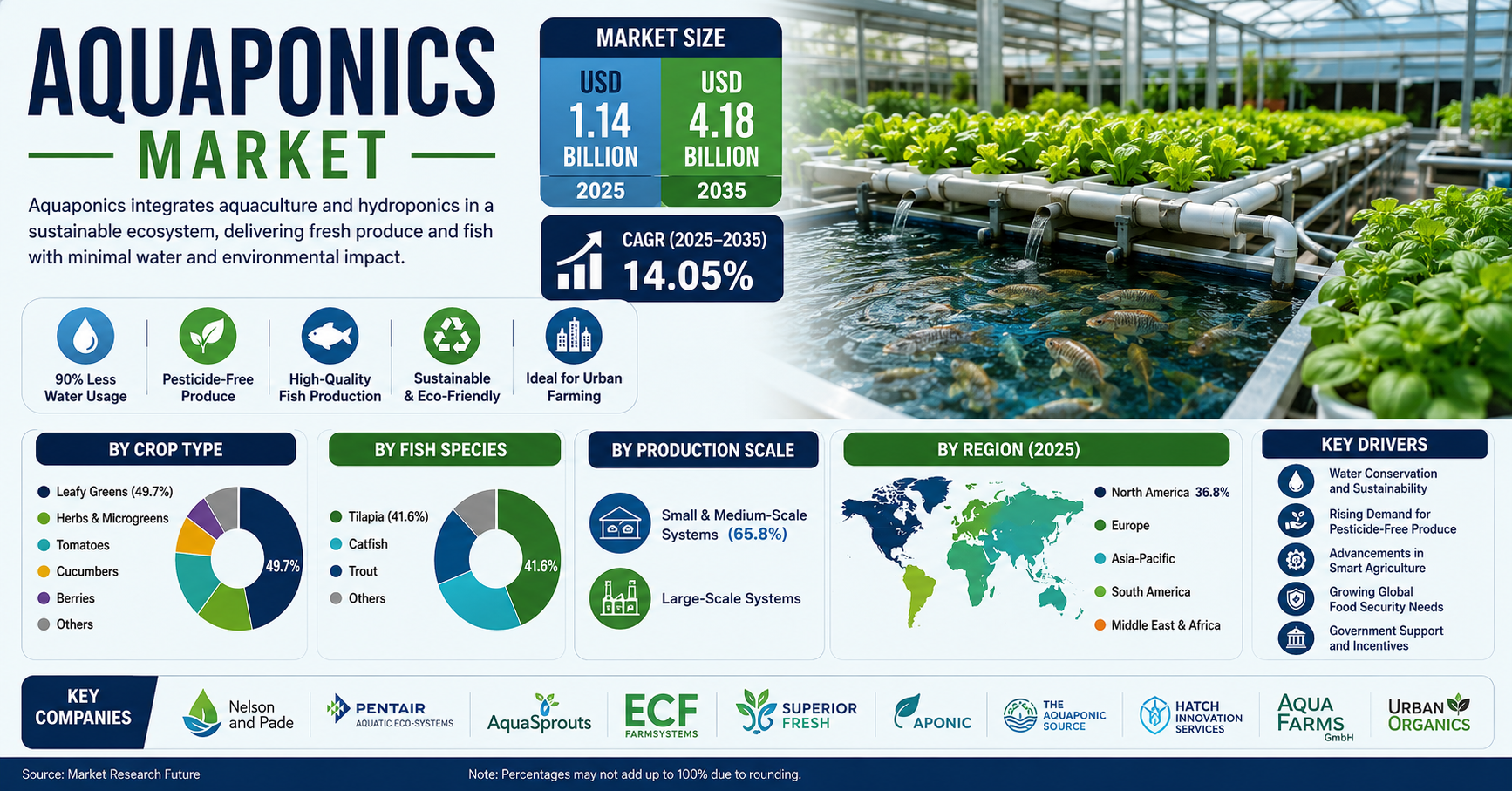
Aquaponics market growth is fueled by urban farming, resource-efficient food production, technological innovation, and increasing global food security needs.
PUNE, MAHARASHTRA, INDIA, June 15, 2026 /EINPresswire.com/ — The global aquaponics market is entering a transformative growth phase as agricultural stakeholders increasingly adopt resource-efficient food production systems. Aquaponics, which integrates aquaculture and hydroponics within a closed-loop ecosystem, is gaining traction as a sustainable alternative to conventional farming methods. Growing concerns regarding freshwater scarcity, climate change, food security, and the environmental impact of traditional agriculture are accelerating market adoption worldwide.
According to Market Research Future, the global aquaponics market was valued at USD 1.14 billion in 2025 and is projected to reach USD 4.18 billion by 2035, expanding at a CAGR of 14.05% during the forecast period. The market’s strong growth trajectory is being supported by technological advancements, government incentives, urban agriculture initiatives, and increasing consumer demand for pesticide-free produce.
Aquaponics systems enable simultaneous cultivation of fish and crops while utilizing significantly less water compared to conventional agriculture. As sustainability becomes a strategic priority for governments, businesses, and consumers, aquaponics is emerging as a viable solution capable of addressing modern agricultural challenges.
Latest Trends Shaping the Aquaponics Market:
1. Integration of IoT and Artificial Intelligence
One of the most significant developments within the industry is the incorporation of Internet of Things (IoT) technologies and artificial intelligence into aquaponics operations. Advanced sensor networks continuously monitor parameters such as dissolved oxygen, pH levels, nutrient concentration, temperature, and water quality. AI-powered analytics enable automated nutrient dosing, predictive maintenance, and optimized feeding schedules, improving operational efficiency and reducing labor requirements.
2. Expansion of Urban Farming Infrastructure
Rapid urbanization has encouraged the development of rooftop farms, vertical farming facilities, and indoor food production systems. Aquaponics is increasingly being integrated into urban agriculture projects, allowing cities to produce fresh vegetables and fish closer to consumers while minimizing transportation costs and carbon emissions.
3. Adoption of Closed-Loop Water Management Systems
Growing water scarcity concerns are driving investments in recirculating aquaponics systems. These systems reuse water efficiently and reduce agricultural water consumption substantially, making them attractive for regions facing groundwater depletion and drought-related challenges.
4. Rise of Modular and Containerized Farming Solutions
The market is witnessing increasing demand for modular aquaponics units and container-based farming systems. These solutions offer scalability, lower infrastructure requirements, and faster deployment, making them suitable for emerging economies and urban environments.
5. Growth of Premium Crop Cultivation
Producers are diversifying beyond conventional leafy greens to include high-value crops such as herbs, microgreens, edible flowers, specialty vegetables, and other premium produce. This strategy enhances profitability and supports direct-to-consumer business models.
Request for PDF Sample Copy: https://www.marketresearchfuture.com/sample_request/2257
Market Drivers:
1. Increasing Water Conservation Requirements
Water conservation remains one of the strongest growth drivers for the aquaponics industry. Governments and regulatory authorities worldwide are implementing stricter water-use regulations, encouraging farmers to adopt technologies that minimize freshwater consumption. Aquaponics systems provide an effective solution by continuously recycling water within the production cycle.
2. Government Support and Agricultural Subsidies
Public funding programs and sustainability-focused agricultural policies are creating favorable conditions for market expansion. Financial assistance programs, grants for controlled-environment agriculture, and incentives promoting sustainable food production are encouraging investments in aquaponics infrastructure.
3. Rising Consumer Demand for Pesticide-Free Produce
Consumers are becoming increasingly health-conscious and are seeking fresh, traceable, and chemical-free food products. Aquaponics-grown produce aligns well with these preferences, offering naturally cultivated vegetables without synthetic pesticide usage. This trend is contributing significantly to market growth.
4. Advancements in Smart Agriculture Technologies
Digital agriculture solutions, automation platforms, data analytics, and AI-driven monitoring systems are improving productivity and reducing operational complexity. These innovations are making aquaponics more commercially viable for large-scale deployment.
5. Growing Food Security Concerns
Global population growth and increasing pressure on agricultural resources are compelling governments and organizations to invest in resilient food production systems. Aquaponics provides year-round food production capabilities while reducing dependence on fertile land and excessive water resources.
Market Opportunities:
1. Container-Based Aquaponics Expansion
Affordable containerized aquaponics systems are creating new opportunities in developing nations and remote regions. These systems require limited infrastructure investment and can be rapidly deployed in urban or rural settings.
2. Data Monetization and Agricultural Analytics
The growing use of sensors and monitoring technologies generates valuable agricultural data. Businesses can leverage this information through analytics platforms, performance benchmarking services, and predictive farming solutions, creating additional revenue streams.
3. Diversification into Specialty Crops
Producers are increasingly exploring premium crops that command higher market prices. Specialty herbs, microgreens, edible flowers, and niche produce categories offer significant revenue potential and improved profit margins.
4. Institutional and Commercial Installations
Universities, healthcare facilities, corporate campuses, and educational institutions are adopting aquaponics systems for sustainability initiatives, food supply management, and educational programs. This emerging customer segment presents considerable growth opportunities.
5. Integration with Renewable Energy Systems
Future aquaponics facilities are expected to increasingly incorporate solar power and energy-efficient technologies, improving sustainability performance and reducing operating expenses while supporting environmental goals.
Segment Analysis:
1. By Crop Type
Leafy Greens – Leafy greens represent the largest segment, accounting for 49.7% of market share in 2025. Crops such as lettuce, kale, spinach, and chard remain highly favored due to their rapid growth cycles, strong consumer demand, and compatibility with aquaponics systems.
Herbs and Microgreens – This segment is expected to register the fastest growth through 2035. Rising demand from restaurants, gourmet food providers, and premium retail channels is supporting market expansion.
Tomatoes – Tomatoes continue to gain popularity due to their year-round cultivation potential and strong commercial demand.
Cucumbers – The cucumber segment benefits from increasing adoption of controlled-environment agriculture and greenhouse farming technologies.
Berries – Berries represent a niche but profitable category, particularly for direct-to-consumer and premium retail markets.
2. By Fish Species:
Tilapia – Tilapia dominates the fish species segment, accounting for 41.6% of market share in 2025. Its adaptability, rapid growth rate, and consumer acceptance make it the preferred species for aquaponics operators.
Catfish – Catfish is projected to experience the fastest growth rate during the forecast period, driven by expanding aquaculture activities and growing protein demand.
Trout – Trout remains an important species, particularly in colder regions where water temperatures are suitable for cultivation.
Others – This segment includes ornamental fish, barramundi, perch, and various specialty species used in integrated farming operations.
3. By Production Scale
Small and Medium-Scale Systems – Small and medium-scale installations accounted for 65.8% of market revenue in 2025. Their affordability, flexibility, and suitability for urban environments continue to drive adoption.
Large-Scale Systems – Large-scale commercial operations are expected to witness rapid expansion as retailers, food service providers, and institutional buyers seek consistent supply and greater production volumes.
Regional Analysis:
North America – North America held the largest share of the global aquaponics market, accounting for 36.8% in 2025. Strong government support, extensive urban farming infrastructure, advanced technology adoption, and increasing demand for sustainable food products continue to strengthen the region’s market position. The United States remains the primary contributor, supported by agricultural grants and favorable policy frameworks.
Europe – Europe represents the second-largest regional market. Sustainability regulations, circular economy initiatives, and growing consumer awareness regarding environmentally responsible food production are driving adoption across the region. Germany, the United Kingdom, France, Italy, and Spain remain key markets.
Asia-Pacific – Asia-Pacific is projected to be the fastest-growing regional market throughout the forecast period. Government support for smart agriculture, food security initiatives, fisheries modernization programs, and urban farming development are contributing to rapid market expansion. China and India are expected to be major growth engines within the region.
South America – South America is benefiting from favorable climatic conditions and a strong aquaculture tradition. Brazil leads regional growth owing to its significant tilapia production capacity and agricultural research investments.
Middle East & Africa – Water scarcity and food security challenges are driving increased interest in aquaponics across the Middle East and Africa. Countries such as Saudi Arabia and the United Arab Emirates are investing in innovative food production technologies to reduce dependence on food imports and improve agricultural sustainability.
Competitive Landscape and Company Profiles:
The aquaponics market remains highly fragmented, with numerous technology providers, equipment manufacturers, and integrated farming operators competing globally. Leading companies are focusing on technological innovation, vertical integration, strategic partnerships, and capacity expansion.
1. Nelson and Pade, Inc: Nelson and Pade is recognized for its commercial aquaponics systems and specialized training programs. The company has established a strong reputation in aquaponics education and system design.
2. Pentair Aquatic Eco-Systems: Pentair Aquatic Eco-Systems provides recirculating aquaculture equipment, filtration technologies, and water management solutions. The company leverages extensive expertise in water treatment technologies.
3. AquaSprouts: AquaSprouts focuses on educational and consumer-oriented aquaponics kits, making aquaponics accessible to households, schools, and learning institutions.
4. ECF Farmsystems GmbH: ECF Farmsystems specializes in urban aquaponics projects and rooftop farming solutions. The company has emerged as a prominent player in European sustainable food production initiatives.
5. Superior Fresh: Superior Fresh operates one of the largest aquaponics facilities in the United States and is known for integrated production of leafy greens and fish.
6. Aponic Ltd: Aponic develops innovative hybrid systems that combine vertical farming and aquaponics technologies, supporting space-efficient food production.
7. The Aquaponic Source: The company offers commercial and residential aquaponics systems, consulting services, and educational resources for growers.
8. Hatch Innovation Services: Hatch Innovation Services supports aquaculture and aquaponics startups through accelerator programs, mentorship, and industry networking initiatives.
9. Aqua Farms GmbH: Aqua Farms GmbH focuses on containerized aquaponics systems designed for easy deployment and scalable production.
10. Urban Organics: Urban Organics is recognized for repurposing urban infrastructure into sustainable food production facilities and promoting circular economy principles.
Recent Developments:
1. September 2025: Superior Fresh completed a 120,000-square-foot expansion project in Wisconsin, significantly increasing Atlantic salmon production capacity while adding new harvesting capabilities for leafy greens.
2. October 2024: Pentair Aquatic Eco-Systems entered a partnership with a Southeast Asian distributor to supply biofiltration and aeration technologies for multiple commercial aquaponics facilities across Vietnam and Thailand.
3. July 2024: The Singapore Food Agency authorized two additional aquaponics operators under its national food security initiative, further expanding commercial aquaponics adoption in the country.
Conclusion:
The aquaponics market is positioned for substantial long-term growth as sustainable agriculture becomes a global priority. Rising concerns regarding water scarcity, food security, environmental sustainability, and urbanization are driving the adoption of integrated aquaculture and crop production systems. Technological advancements, supportive government policies, and increasing consumer demand for pesticide-free produce are further strengthening market prospects.
With North America maintaining market leadership, Asia-Pacific emerging as the fastest-growing region, and innovations such as AI-enabled farm management, modular production systems, and premium crop diversification gaining momentum, the aquaponics industry is expected to play a pivotal role in the future of sustainable food production. As investments continue to increase and commercial scalability improves, aquaponics is likely to become an essential component of modern agricultural ecosystems worldwide.
Sagar Kadam
Market Research Future
+18556614441 ext.
sales@marketresearchfuture.com
Visit us on social media:
LinkedIn
Facebook
X
Legal Disclaimer:
EIN Presswire provides this news content “as is” without warranty of any kind. We do not accept any responsibility or liability
for the accuracy, content, images, videos, licenses, completeness, legality, or reliability of the information contained in this
article. If you have any complaints or copyright issues related to this article, kindly contact the author above.

Media gallery