
A Preliminary Exploration of Counterfeit Goods in Huaqiangbei
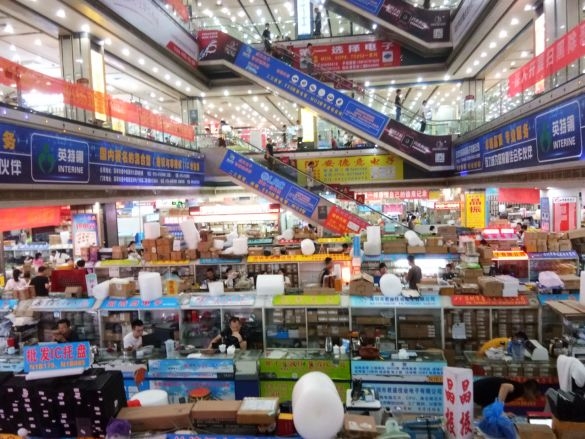
Huaqiangbei, the renowned electronics trading hub, distribution center, and ecosystem core — officially designated “China’s First Electronics Street” by national authorities — was once spoken of in the same breath as Beijing’s Zhongguancun. Where there are profits, there is an underworld, and Huaqiangbei is no exception. The genuine and the fake, the real and the illusory, isn’t that part of Huaqiangbei’s unique charm? What types of counterfeit goods exist in Huaqiangbei? I’m Lao Song from Kinghelm, a BeiDou GPS antenna company, and as Huaqiangbei’s most verbose street-economy commentator, I’d like to share the insider knowledge I’ve accumulated from years of deep immersion in this world.
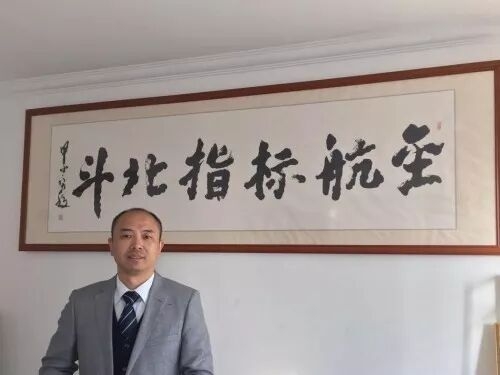
Song Shiqiang, General Manager of Kinghelm
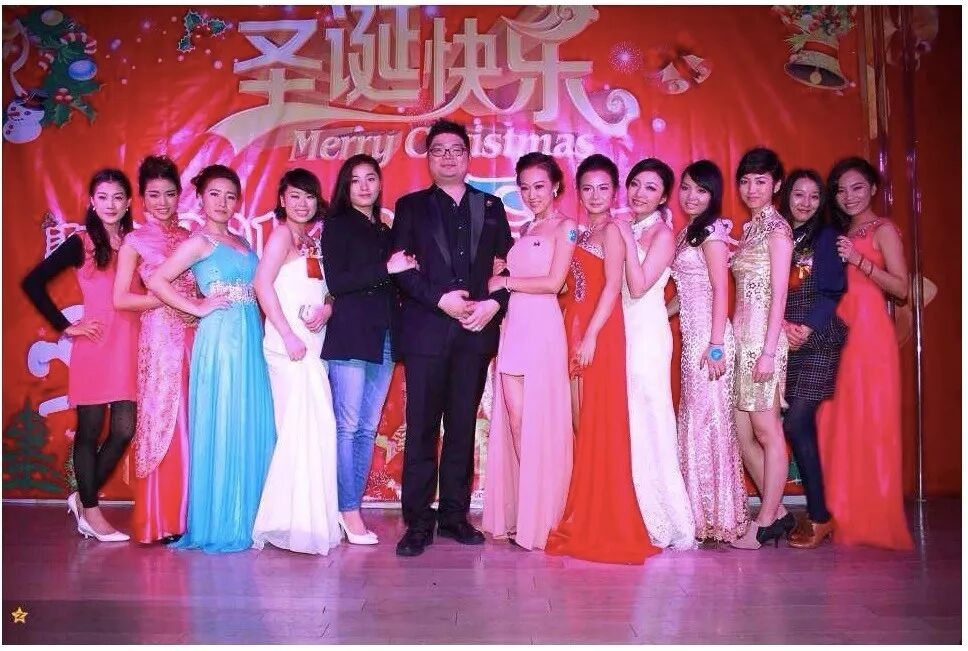
The counterfeit goods of Huaqiangbei have one achievement worth “bragging about”: they once penetrated the U.S. military supply chain and ended up in cutting-edge fighter jets. In Huaqiangbei, you can assemble an iPhone for a few hundred yuan in half a day. The latest Huawei phones can be obtained two days before their official release. Imitations of the world’s newest digital products from anywhere on the globe can be found within three days — that is Huaqiangbei’s core competitive edge. To understand the types of fake goods, we need to analyze them from several angles. It’s a bit like how I try to assess the “vintage” proprietresses of Huaqiangbei — the ones who’ve been around the block and carry their experience with quiet authority. You observe whether they’ve been seasoned by the years; you take stock of how life has shaped them; you check whether they’ve made it official somewhere along the way; and you consider whether, like certain celebrity couples who famously declared “we are not who we once were, yet we still share the same door,” they’ve reinvented themselves entirely — only to come full circle again. Round and round it goes, layer upon layer of history. The old physician’s method of observe, listen, inquire, and examine serves well here too. But of course, this is all loose talk over tea and wine. In reality, these proprietresses run their businesses with sharp minds by day and raise families — sometimes quite large ones — by night. The proper term for them, really, is “second-time entrepreneurial businesswomen.”
Now let me, Lao Song of Kinghelm BeiDou GPS antennas, return to the main subject of counterfeit goods in Huaqiangbei.
I. Disassembled and Refurbished Goods
These originate from overseas electronic waste, largely sorted and roughly processed in areas centered around Chendian Town and Guiyu Town in the Chaoshan region. Using the most brutally simple yet efficient methods — described colloquially as “smoke-roasting and hammer-smashing, acid-washing and alkali-bleaching, scooped up with a strainer” — the disassembly process causes severe environmental pollution that is difficult to control. Over time, operations were gradually forced to relocate to remote areas like Qingyuan, eventually going underground and operating as a guerrilla enterprise, while sales continued to flow primarily through Huaqiangbei in a front-shop-back-factory model. There is also what is commonly called “bulk cargo” — entire shipping containers or boatloads of goods purchased wholesale and then resold in smaller quantities. Imported electronic waste enters China priced by the vehicle, vessel, container, or sack, with the value benchmarked against the yield of precious metal smelting on-site. It is then sold by the jin, by the pile, by the box, or even by the number of IC pins — essentially enormous returns on minimal investment. The volumes involved are not small. After processes including sorting, testing, acid-washing, polishing, remarking (via silk-screen or laser printing), taping into reels, and packaging, most of this material ends up being sold in Huaqiangbei through a fully integrated production line. Repairing pins and replanting BGA solder balls is itself a thriving trade, with packaging designed to pass for genuine product. Many of Huaqiangbei’s early overnight-millionaire stories trace back to this industry. After striking their first pot of gold, some people changed industries, some laundered their reputations, some settled into a life of leisure and enjoyment. Others upgraded their operations and pushed up the value chain, evolving from traders into original manufacturers with their own brands, distribution channels, R&D departments, and production facilities.
Capacitors and resistors have such low individual value that refurbishing them isn’t worthwhile; they go straight to precious metal smelters along with PCB boards. Chips with flash memory tend to degrade in function over time and are rarely refurbished for reuse. For disassembled components whose function remains intact, Huaqiangbei’s price-to-performance ratio is actually quite respectable — the product range is broad, the supply chain is mature, sourcing is convenient, and supporting services are comprehensive. This is part of why Huaqiangbei remains an active and legitimate market, regularly drawing buyers from across the country and even from abroad in search of legacy chip models. According to insiders, some foreign companies needing X86 chips for legacy equipment repairs source them through Huaqiangbei.
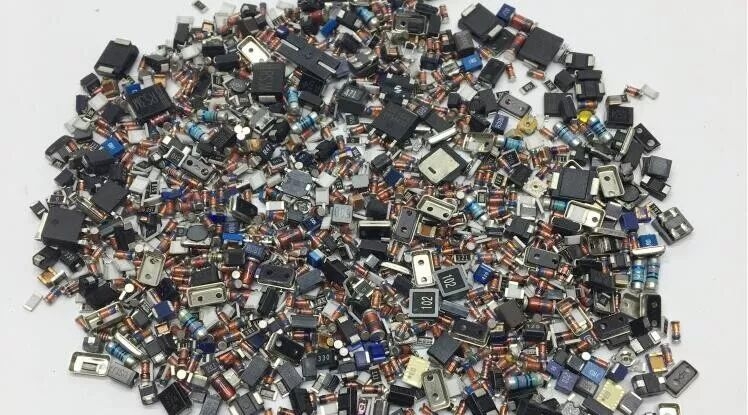
Disassembled components
Outside the Chaoshan region, areas in Zhejiang such as Lishui and Cixi had similar industries during the 1980s and 90s, mostly supplying markets like Zhongfa and Hailong in Beijing’s Zhongguancun. However, the scale was smaller, the lifespan shorter, and the workforce much more limited.
II. Out-of-Spec New Goods (Scatter New)
In industrial production, a certain pass-through rate is maintained to ensure product quality and consistency. After processing at a foundry, rigorous testing is conducted, and dies on a wafer that fail inspection are marked with a red dot. These components, though substandard, still retain some usable value. They are acquired through various channels at scrap prices, then subjected to basic testing and sorting before being offered for sale. Some also emerge from the assembly and testing stage at the factory. This category is known in the trade as “scatter new goods.” Huaqiangbei sellers with more audacity sell them outright as genuine original parts, while those with a slightly clearer conscience — or more caution — will label them for what they actually are. Compared to genuine originals, scatter new goods fall short in areas such as current and voltage ratings, insulation grade, yield rate, electrical specifications, and pin flatness. In storage products, the discrepancy often shows in capacity. Nevertheless, they can be used in a downgraded capacity for specific applications, and during supply shortages or after original products are discontinued, some traders have made handsome profits from them.
I was once told by someone in the industry that storage components are generally classified in the trade as “white chips” and “black chips” — referring to genuine originals and scatter new goods respectively. Black chips may have some sectors or quadrants damaged, resulting in smaller capacity and inferior performance, but they can still serve in a pinch. The suspiciously cheap USB drives and memory cards you find in Huaqiangbei are almost certainly sourced this way.
III. Relabeled Goods
This category accounts for enormous volume and is concentrated primarily in lower-grade products such as resistors, capacitors, and small-signal diodes and transistors. The practitioners are somewhat more sophisticated — these “second-hand proprietresses” not only know the 26 letters of the alphabet but can also read basic English product specifications. Where technical parameters are identical or sufficiently similar, they substitute one brand for another: LRC for SHARP, Yageo for Samsung, CJ for AOS, and countless other permutations.
In a corner of the third floor of the old Huaqiang Market, there used to be several small shops specializing in remarking services. Their computers held logos, part-numbering conventions, barcodes, and QR codes for every major brand, and a few years ago people would queue up to have their goods remarked. Traders doing enough volume simply bought their own marking machines.
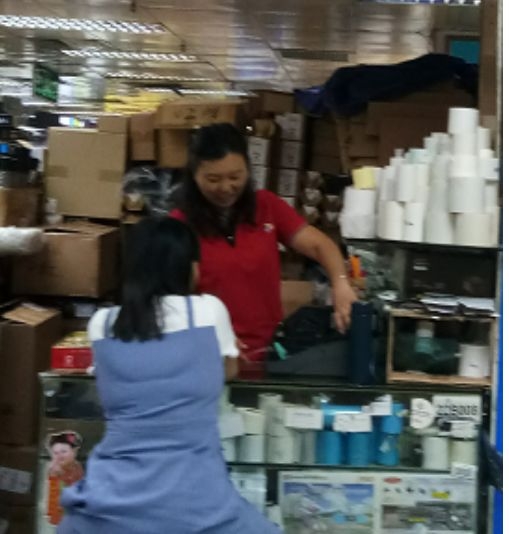
A small remarking counter
One dealer I know by the surname Liu took things even further. He first spent considerable money to secure an authorized distributorship for Rohm, then brazenly relabeled products from CJ or UTC as Rohm — pocketing a massive price differential in the process. Before long he was driving a brand-new BMW X6. Another wealth story from Huaqiangbei. Out of gratitude for his beer sponsorships at our events, I’ll refrain from naming him — not that he’d ever admit to it anyway.
IV. Misgraded Goods
This refers to the practice of passing off inferior goods as superior ones — substituting a lower grade for a higher grade. The same product line gets sold up the hierarchy: commercial grade passed off as industrial grade, industrial as military grade, military as aerospace grade. The brand and part number stay the same; only the suffix needs changing. Swap an “I” for a “V” and the asking price doubles. There is also the practice of inflating capacity: a 256K part sold as 512K, a 512K sold as 1G — rampant in the storage sector. For MCUs, DSPs, FPGAs, and similar products, the manipulation targets processing speed, resolution, and other performance metrics.
In my estimation at Kinghelm, the goods that penetrated the U.S. military supply chain were most likely of this variety. Problems wouldn’t surface during standard on-board testing and burn-in, but would emerge under demanding operating conditions or after extended periods of use.
There is also what Huaqiangbei calls “big chip” and “small chip” — a distinction based on the physical size of the semiconductor die. The pattern is systematic: a 0.8A part sold as 1.0A, a 1.0A as 1.2A, 3.3V passed off as 5V, and so on following a predictable progression. Other forms of misrepresentation in key electrical parameters — on-resistance, breakdown voltage, junction capacitance — are too numerous to list individually. When fellow traders in Huaqiangbei do business with each other, they typically give each other a heads-up and sort out the details among themselves, leaving the end customer as the one footing the bill.
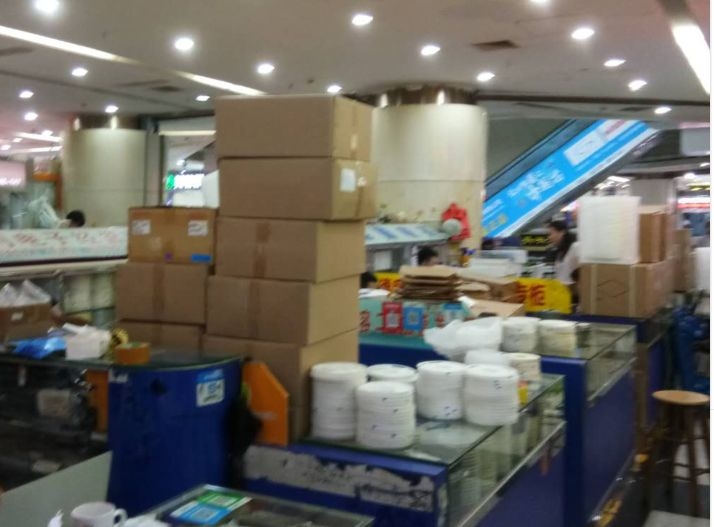
Relabeled goods
V. Domestic Substitute Goods
When a foreign-branded part is discontinued but market demand persists, domestic fabless IC design companies will reverse-engineer and reproduce it. Due to the inherent limitations of reverse engineering, or because costs or target markets led to stripped-down versions retaining only core functionality — combined with comparatively less mature process technology and assembly and testing capabilities — these domestic substitutes fall short of the originals in multiple respects. To open markets while managing risk exposure, design companies often ship these as “white label” (also called “neutral”) products, leaving Huaqiangbei distributors free to apply whatever brand and packaging they choose. Everyone understands the arrangement and walks away satisfied.
Years ago, a particular IC used in high-definition cameras — part number UPD6453, made by NEC — retailed for around 18 RMB. A company in Hangzhou reverse-engineered it, bringing the production cost down to 3.5 RMB. A Huaqiangbei dealer surnamed Zhou sold this part for three months straight and bought a Range Rover. In 2011, severe flooding in Thailand shuttered a Sanyo Semiconductor factory, causing the discontinuation of the 2SC2078E power amplifier transistor used in Motorola GP88 walkie-talkies. Normally priced at USD 0.25, spot-market prices for remaining inventory shot up to 8 RMB per unit. Only after domestic companies like Wuxi Gudian and Quanguang developed their own versions — priced at just 0.5 RMB — did the market stabilize. The quality gap remained, of course, and I noticed some Huaqiangbei sellers packaging the domestic version as genuine Sanyo product.
The technological capabilities of China’s domestic integrated circuit industry are growing stronger by the year, backed by increasing government support and an improving market environment. Domestic design and packaging-and-testing companies are now able to promote their own brands openly and build their own sales channels — a genuinely sustainable path forward.
For more products, visit www.kinghelm.net
Huaqiangbei’s other sources of goods include stolen merchandise, goods confiscated and auctioned by customs, and surplus or returned inventory from failed or downsizing ODM factories. Ten years ago, when I visited an old acquaintance in Wanfeng Industrial Village in Shajing Town, I witnessed workers at Wang’s Electronics smuggling ICs and solder paste home to their rental apartments in thermos flasks — yet another layer adding to the complexity and disorder of Huaqiangbei’s supply chain.
With so many counterfeit goods in Huaqiangbei, outsiders are frightened and insiders are anxious. Anyone who has never been cheated in Huaqiangbei hasn’t really been part of Huaqiangbei. Our own Kinghelm company used to operate a trading division sourcing electronic components for customers in the BeiDou GPS industry, and we regularly purchased fake goods that required us to compensate our clients. It was an endless battle, exhausting and demoralizing. The fakes pushed us well past our limits of tolerance. Government commercial and technical supervision authorities have regularly conducted anti-counterfeiting operations, but as soon as the news spreads, dozens of counters and shops shutter for the day — another uniquely Huaqiangbei phenomenon.
On one visit to see Dr. Zhu Junshan, the founder of ZhongyiFa, the most educated and culturally refined elder statesman of Huaqiangbei and a man deeply concerned with the psychological wellbeing of the market’s prosperous young proprietresses, I noticed a microscope sitting on his desk beside a copy of Jin Ping Mei. He told me that every component he sources from the market gets checked under the microscope — and that by now his experience allows him to tell genuine from fake with his naked eye.
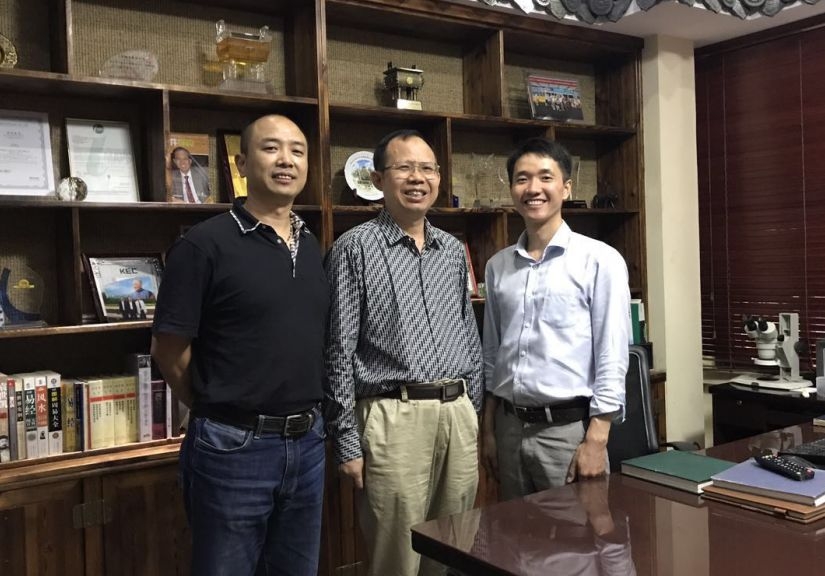
Dr. Zhu (center) and his microscope
My good friend Jason Fan (Fan Yi) of Anda Technologies — the man who achieved Huaqiangbei’s most impressive weight-loss transformation — runs Singapore-based Anda, which specializes in sourcing scarce genuine components from around the world. He has made public an internal reference library built up over many years, covering how to identify authentic goods across dimensions including brand, country of origin, labels, packaging boxes, anti-static bags, date codes, typefaces, barcodes, trays, pin condition, orientation holes, color, and logo details. The company’s social media account, “Chip Advisor,” has published dedicated articles on the subject. This is a genuinely public-spirited contribution — cutting through the murk and upholding integrity in the industry.

Jason Fan (Fan Yi), Managing Director of Anda Technologies Singapore (center)
Beyond informal experience-based methods, some companies have turned authentication into a professional business, offering services such as decapping, dissolving encapsulant, reading die-level markings, performance testing, and failure analysis, backed by industry databases and reference libraries. One such company, Baima Testing, has built a thriving operation.
The electronics component market model of Huaqiangbei was the product of a specific era: the backdrop of massive international industrial relocation and China’s period of extensive economic growth, during which demand for electronic components was both enormous and highly diversified. The proliferation of counterfeits has severely damaged the reputation of “China’s First Electronics Street,” disrupted the social and economic order, and eroded Huaqiangbei’s standing. As society develops, market information becomes increasingly symmetric, and the legal environment grows steadily more rigorous. The hope is that Huaqiangbei will give rise to more companies like Tencent, Hytera, and Longsys — enterprises with genuine technology, strong growth trajectories, and meaningful contributions to the broader economy — completing Huaqiangbei’s long-overdue upgrade and transformation. With the joint efforts of government, merchants, and consumers, may counterfeit goods be driven out of the market, and may Huaqiangbei be built into a paradise for electronics and digital products — the most brilliant calling card of Shenzhen, the Greater Bay Area, and all of China.

Let us all cheer Huaqiangbei on together with Kinghelm!
Media Contact
Company Name: Shenzhen Kinghelm Electronics Co., Ltd.
Contact Person: Support
Email: Send Email
Phone: +86 0755-83975897
Address:18/F, Building T2, Lijincheng Center, Longhua
City: Shenzhen
Country: China
Website: www.kinghelm.net
Press Release Distributed by ABNewswire.com
To view the original version on ABNewswire visit: A Preliminary Exploration of Counterfeit Goods in Huaqiangbei


