Frisco, TEXAS, April 27, 2026 (GLOBE NEWSWIRE) — Concierra Legal, a boutique law practice focused on complex business risk and contract strategy, announced today the introduction of its strategic contract architecture approach designed to help founders and entrepreneurs address the growing legal and financial risks associated with using artificial intelligence in contract drafting. As AI-generated agreements become more widely adopted, the firm’s approach applies litigation-tested analysis to identify hidden exposure in standard contract language and design agreements aligned with each business’s operational realities, risk profile, and jurisdictional requirements.

Michelle May O’Neil, founder of Concierra Legal and strategic legal architect, warns small business owners that AI contract drafting tools are introducing significant financial and litigation risks into everyday business agreements.
As small business owners race to use artificial intelligence to save money on legal fees, a dangerous blind spot is emerging. While AI platforms can generate contracts in seconds, strategic legal architect Michelle May O’Neil, founder of Concierra Legal, warns that relying on these automated tools—without knowing what to look for—is quietly introducing massive financial risks into everyday business agreements. AI may solve for speed, but AI does not know your business, cannot price your actual exposure, and has no idea what your contract will look like from the witness stand.
Five Reasons AI Should Not Write the Contract
AI contract tools are trained on legal forms not on the specific realities of running a business. A contract that looks complete on its face can become the most expensive document the business ever signed leading to business-ending litigation. These are the five patterns that show up when contracts end up in litigation after it is too late to fix them.
1. The “Month One” Free Pass for Bad Vendors
AI routinely inserts standard clauses limiting vendor liability to the “fees paid in the previous 12 months” without understanding the business’ operational realities or cash flow considerations. For example, if that vendor causes a catastrophic failure—a data breach, a system crash, a missed delivery that shuts down operations—during Month 1, before a single invoice has been paid, their liability is legally capped at zero. The entire loss falls on the business owner. What looks like standard contract language is actually a clause that eliminates the other party’s accountability during the period of highest risk.
2. The “Hold Harmless” Trap Hidden in Plain Sight
AI tools copy standard indemnification language because it looks professional. But the boilerplate phrase “hold harmless” requires a business owner to pay out of pocket, upfront, to defend the other party in litigation even when the business owner was not at fault. What reads like generic legal housekeeping may create a large financial exposure. A founder who signs without understanding that clause may find themselves funding someone else’s legal defense before a court has decided anything.
3. Accidentally Signing Away Your Intellectual Property
When the model relies on templates certain default clauses may be inserted that don’t relate to the issues at hand. Clauses addressing use of intellectual property may be standard, but if used inappropriately may give away certain IP rights to a third party. Such clauses could inadvertently grant a vendor the right to use the business’s proprietary work, processes, or customer data to train that vendor’s AI models, without the founder ever realizing what they signed. For a business built on a proprietary method, a client list, or a brand identity, this is an existential risk.
4. Playing Roulette with State Law
AI tools may default to a jurisdiction for choice of law, like Delaware or New York, as the governing law because those jurisdictions are statistically common in the contracts they were trained on. But choosing the wrong state can silently destroy legal defenses a founder assumed they had. New York law, for example, strictly voids liability limits when gross negligence is involved, but Delaware does not. Texas has specific statutes governing non-subscriber workers’ compensation, the Deceptive Trade Practices Act, and construction trust fund obligations that interact with contract language in ways a generic template will never address. An AI will not tell a founder that its geographic default just nullified their liability shield.
5. Feeding Your Trade Secrets Into a Public System
When founders (or their employees) paste confidential client details, proprietary pricing, or trade secrets into an open AI platform to generate a contract, they may be simultaneously creating a data privacy exposure. Depending on the platform’s terms of service and the nature of the information entered, that data may be used to train future AI models, accessible to platform personnel, or potentially discoverable in litigation. For a business whose competitive advantage lives in what it knows and how it operates, the act of drafting the contract can itself become the risk.
What Three Decades of Litigation Experience Reveals—and What to Do About It
“The most dangerous contracts I have seen were not drafted by bad lawyers,” O’Neil said. “They were drafted by people—or systems—that did not understand what the contract would look like in the courtroom. Every one of these five problems has a solution. But the solution requires a human being who has actually seen what goes wrong.”
Research shows that nearly 90% of small and mid-sized businesses encounter litigation at some point in the business’ lifecycle. Regardless of outcome, the litigation itself can drain cash resources, steal leaders’ attention, and threaten the foundation of the business. For many founders, a single lawsuit is the most expensive event in the life of their company. The average cost of commercial litigation for a small business exceeds $90,000, according to U.S. Chamber of Commerce data. That cost dwarfs the cost of getting the contract right before it is signed.
The Strategic Legal Architect: Getting Ahead Before the Stakes Get Expensive
AI tools will improve but they are a long way from exercising sound human judgment. An experienced legal strategist sees how agreements perform under pressure and knows how to design them for the specific business, industry, and risk profile of the client. Concierra Legal was founded on that premise, serving founders, entrepreneurs, and professionals whose matters are too complex, too consequential, or too personal to be handled like a commodity.
Where AI sees a template, a strategic legal architect sees the business behind the signature. The Month One liability trap is fixed by understanding how the vendor relationship actually works and drafting caps that reflect the real risk window. The hold harmless trap is fixed by negotiating indemnification language that is specific to the deal, not copied from a generic form. The IP exposure is fixed by reviewing every clause that touches data, process, or proprietary method before the agreement is signed. The state law problem is fixed by building governing law provisions around the statutes that actually protect the business. And the end-of-relationship risk is fixed by designing exit provisions, dispute resolution mechanisms, and buyout structures from the first day of the relationship—not the last.
From the Courtroom to the Boardroom
O’Neil co-founded and led O’Neil Wysocki, P.C. also known as OWLawyers, a Dallas-based law firm known for its trial and appellate practice in complex litigation, for two decades. O’Neil recognized a pattern in disputes arising from the same preventable contract failures. She applied the same analytical discipline she learned from years in the courtroom to the boardroom where it would apply far upstream before disputes ever materialized.
Now, O’Neil founded Concierra Legal to reflect that evolution. The courtroom discipline and strategic judgment developed across decades of litigation she now applies at the contract design and business structure stage—where the cost of getting it right is a fraction of the cost of getting it wrong.
About Concierra Legal
Concierra Legal is a boutique law practice serving founders, entrepreneurs, and professionals whose matters are too complex, too consequential, or too personal to be handled like a commodity. Led by nationally recognized trial and appellate attorney Michelle May O’Neil, the firm provides strategic legal counsel for contract architecture, business structure, risk assessment, and complex personal matters. Concierra Legal maintains a selective client roster and is confidential from first contact.
About Michelle May O’Neil
Michelle May O’Neil is board-certified by the Texas Board of Legal Specialization in family law with 34 years of trial litigation and appellate experience. She has tried 37+ jury trials and handled 165+ appellate cases, including 55 before the Texas Supreme Court and a case filed in the United States Supreme Court. She holds AV Preeminent and Judicial AV ratings from Martindale-Hubbell, is recognized among the Best Lawyers in America, and has been listed among Texas Super Lawyers for 16 consecutive years. She has been named to the list of the Top 50 Texas Women Super Lawyers for 11 years. O’Neil co-founded O’Neil Wysocki, P.C. (OWLawyers.com), which she led for two decades. She was named to the inaugural Thought Leaders 100 and the Editorial Board of Thought Leaders Press and is the author of the forthcoming book The Fifth Move. In her new venture, O’Neil Concierra Legal (ConcierraLegal.com) and Concierra Business (ConcierraBusiness.com) to provide concierge strategic architecture for the entrepreneurs, founders, and professionals that she has represented for many years.
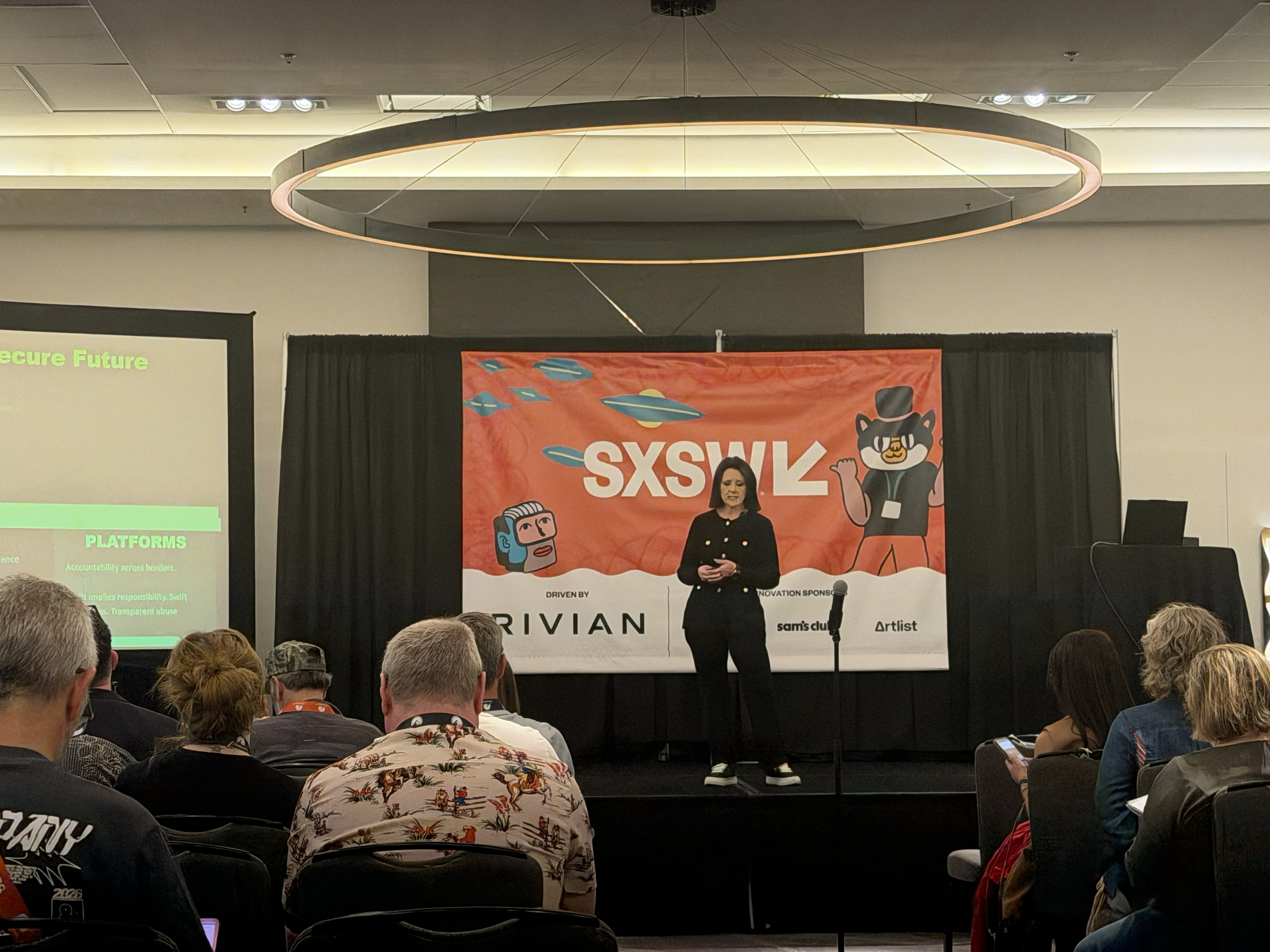
Michelle May O’Neil speaks at SXSW 2026, where she introduced the Identity Stack™ framework addressing emerging battles around identity, AI, and ownership in the creator economy.
About Concierra Legal
Concierra Legal is a boutique law practice providing concierge-level legal counsel for founders, entrepreneurs, and professionals whose matters are too complex, too consequential, or too personal to be handled like a commodity. The firm was founded on a single premise: the judgment that wins cases in the courtroom is most valuable when applied upstream—before disputes materialize, before contracts create exposure, before legal problems become crises. Led by Michelle May O’Neil, a Board Certified trial attorney with 34 years of litigation and appellate experience and a record spanning 37+ jury trials, 165+ appellate cases, and 55 arguments before the Texas Supreme Court, Concierra Legal serves as a strategic legal architect for clients navigating high-stakes intersections of business, identity, and personal consequence. The firm maintains a selective client roster and is confidential from first contact. ConcierraLegal.com
Press Inquiries
Michelle May O’Neil
michelle [at] concierralegal.com
214-676-9051
https://ConcierraLegal.com
5 Cowboys Way
Suite 300, MB #90
Frisco, Texas 75034
A video accompanying this announcement is available here: https://youtube.com/watch?v=_buZCd6Juag


