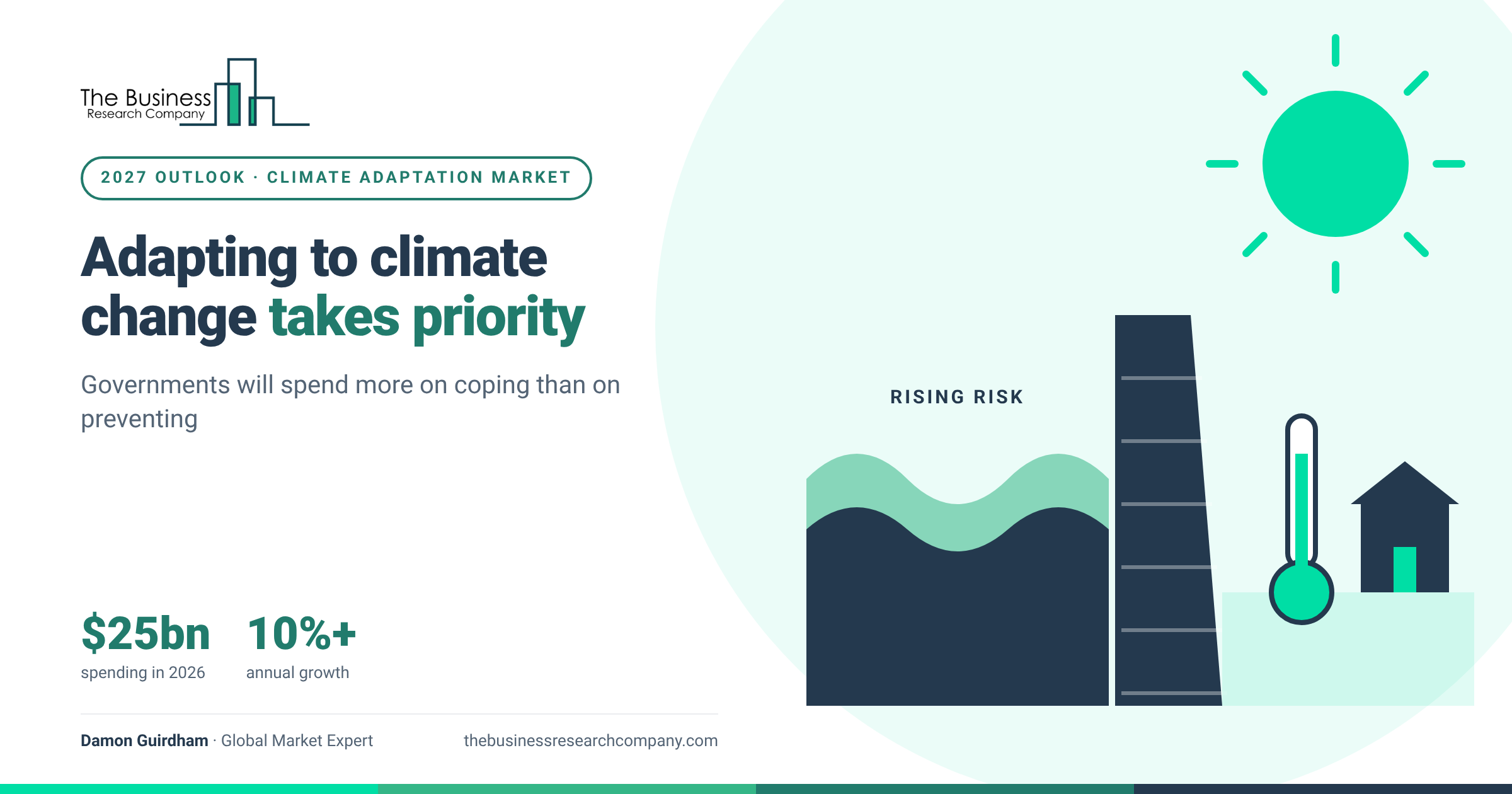
The Business Research Company’s Climate Adaptation Market Outlook 2027: Why Governments Will Spend More on Coping With Climate Change Than Preventing It
LONDON, GREATER LONDON, UNITED KINGDOM, November 26, 2026 /EINPresswire.com/ — Key takeaways
• Governments will spend more on coping with climate change than on preventing it.
• The Business Research Company expects climate adaptation spending to grow from $25 billion in 2026 at more than 10% a year over the next five years.
• Emissions goals will be dropped where they hurt competitiveness or consumer costs, while adaptation, long neglected, gains momentum.
Europe is the fastest-warming continent in the world. The heatwaves and wildfires of recent summers have made that impossible to ignore. Climate change is no longer a long-term abstraction for European voters; it’s something they see and feel directly.
When we sat down for our 2027 Outlook Roundtable, I described how that experience is changing climate policy. We see a big policy shift in Europe away from reducing emissions towards spending on adaptation.
I’d go further. Governments will spend more on coping with climate change than on preventing it. That’s a significant change in direction, and it creates a fast-growing market that many investors have yet to notice.
Exploring opportunities in climate resilience and adaptation? Let us get to know each other.
Why European Climate Policy Is Shifting From Net Zero to Adaptation
For three decades, Europe has pursued aggressive emissions reduction. Carbon penalties, subsidies for renewables, the near-elimination of coal and ambitious net zero targets have all been part of the strategy. In a narrow sense, those policies succeeded: Europe’s emissions have fallen substantially.
In a broader sense, they failed. Global emissions aren’t Europe’s to control, and the climate has kept warming. At the same time, the cost of these policies has fed a cost-of-living backlash. Voters are increasingly unwilling to pay more for energy and goods in pursuit of goals they see slipping away.
So emissions goals will be dropped where they hurt competitiveness or consumer costs, while adaptation, which has been massively neglected, finally gets attention.
Curious how these climate adaptation trends play out in your market? Get in touch.
Climate Adaptation Market Size: From $25 Billion in 2026 at More Than 10% a Year
The Business Research Company expects spending on climate adaptation across agriculture, water management and urban planning to grow from $25 billion in 2026 at more than 10% a year over the next five years.
Adaptation is attractive to governments for a simple reason. Its benefits are visible and local. A flood defence, a cooled public building or a new firefighting capability protects people that voters know, in places they live. That’s a much easier case to make than spending to reduce global emissions over decades.
• Water management, flood defence and drought resilience
• Climate-resilient agriculture
• Urban planning, cooling and heat resilience
• Wildfire prevention and firefighting capability
Want our forecasts for a specific climate adaptation segment? Book a call with our research team.
How Neglected Climate Adaptation Has Been: The UK Firefighting Example
Here’s an example of how far behind adaptation has fallen. The UK doesn’t own a single firefighting aircraft. It has only just announced investment in that capability, despite a series of serious wildfire seasons.
Similar gaps exist across Europe, in water infrastructure, heat-resilient buildings, drainage and agricultural resilience. Closing them will take years of sustained investment, and the work spans national governments, local councils, utilities and private landowners, which is exactly why we see a durable growth market rather than a short-term response.
Our analysts can size the climate adaptation opportunity for your region. Start a conversation with us.
What the Shift to Climate Adaptation Means for Business and Investors
1. Infrastructure, engineering and construction firms gain a long pipeline of public projects
2. Agriculture and water technology companies benefit from resilience spending
3. Insurers and property owners face rising pressure to invest in protection
4. Businesses relying on emissions-reduction subsidies should plan for change
The energy transition won’t stop. As my colleague Oliver Guirdham argues, renewables are now winning on economics alone. But the policy energy, and much of the new public money, is shifting towards helping societies cope with the climate that’s already arriving.
If you’re repositioning for the shift to adaptation, reach out to our team.
Every figure here can be broken down by region and segment. Let us get to know each other, and we’ll walk you through the numbers that matter to you.
Frequently asked questions
What is climate adaptation?
Spending and policy aimed at coping with the effects of climate change, such as heatwaves, floods, droughts and wildfires, rather than preventing it.
How fast is the climate adaptation market growing?
We expect spending to grow from $25 billion in 2026 at more than 10% a year over the next five years.
Why are governments shifting from net zero to adaptation?
Global emissions are beyond any one region’s control, the cost of net zero policies has fed a cost-of-living backlash, and adaptation delivers visible local benefits.
Speak With Our Expert:
Saumya Sahay
Americas +1 310-496-7795
Asia +44 7882 955267 & +91 8897263534
Europe +44 7882 955267
Email: marketing@tbrc.info
The Business Research Company – www.thebusinessresearchcompany.com
Follow Us On:
• LinkedIn: https://in.linkedin.com/company/the-business-research-company
About The Business Research Company
The Business Research Company is a market intelligence firm with more than 350 researchers and offices in the UK, the US and India. Its Global Market Model covers 27 industries and more than 60 geographies, providing market sizes, forecasts and analysis for businesses, investors and governments worldwide.
Oliver Guirdham
The Business Research Company
7882 955267
info@tbrc.info
Visit us on social media:
LinkedIn
Legal Disclaimer:
EIN Presswire provides this news content “as is” without warranty of any kind. We do not accept any responsibility or liability
for the accuracy, content, images, videos, licenses, completeness, legality, or reliability of the information contained in this
article. If you have any complaints or copyright issues related to this article, kindly contact the author above.

Media gallery