

Chinese-developed technology moves decoding into orbit, extending the reach of satellite computing to everyday users.
BEIJING, CN / ACCESS Newswire / November 24, 2026 / The Institute of Artificial Intelligence of China Telecom (TeleAI) has completed an on-orbit validation of AI Flow, a generative transmission system that decodes token streams aboard a satellite and sends reconstructed high-definition video to the ground. The test marks an important step toward putting orbital computing to work for a wider range of users.
First Satellite-to-Ground Generative Transmission
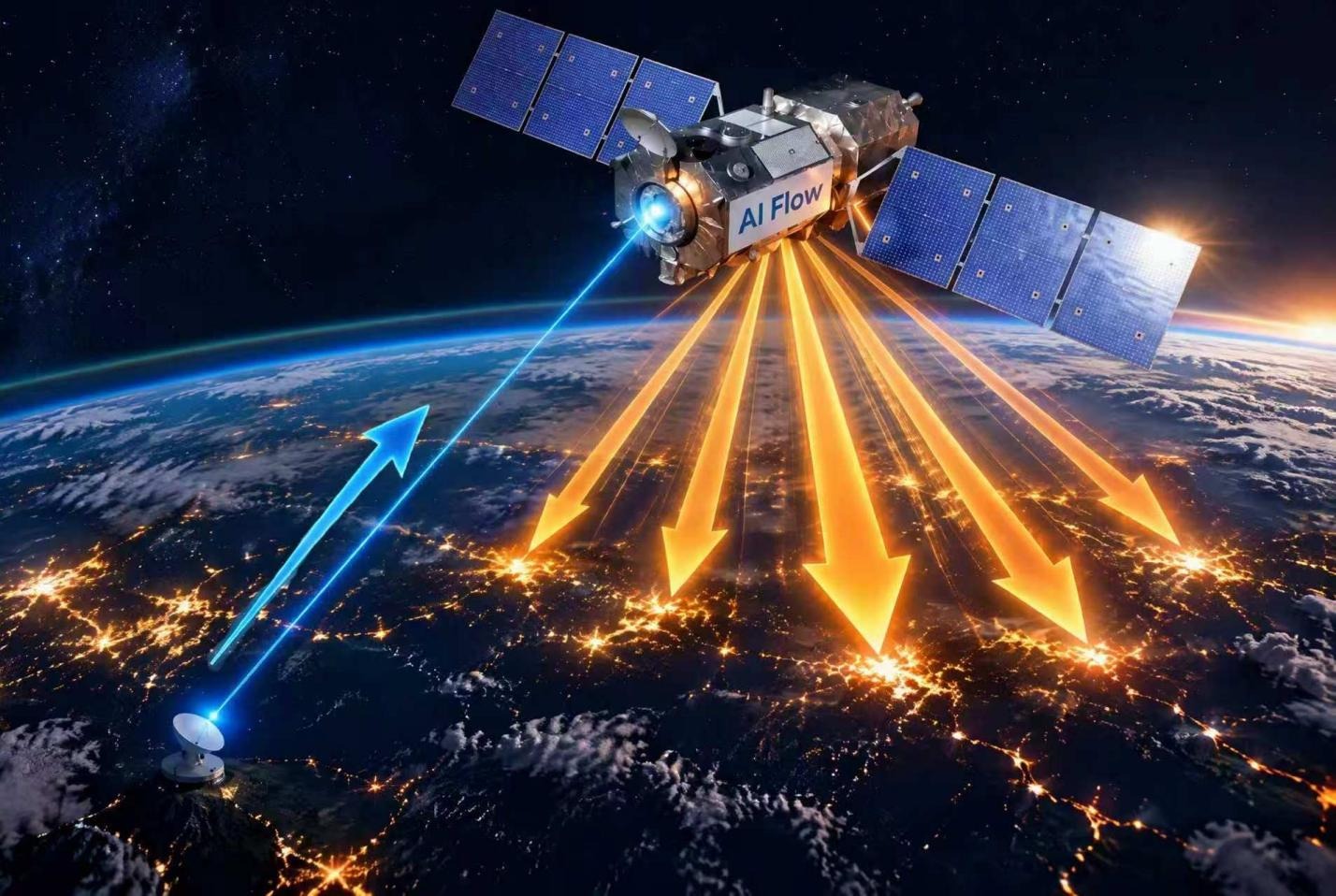
In an earlier satellite test, the spacecraft acted only as a relay, and decoding still took place on the ground. This latest validation marks the first end-to-end satellite-to-ground test of AI Flow’s Generative Transmission (GenTrans): token streams were sent to an in-orbit computing payload, decoded and reconstructed aboard the satellite, then delivered as high-definition video to ground receivers through the satellite downlink. By connecting orbital computing directly with users on Earth, the test demonstrates how generative transmission can put more of a satellite’s onboard computing capacity to use, beyond data collection and relay.
How GenTrans Works
AI Flow was independently developed by a TeleAI research team led by Professor Xuelong Li, Chief Technology Officer and Chief Scientist of China Telecom and Director of TeleAI. Unlike conventional audiovisual transmission systems that rely on transferring large volumes of compressed data, its Generative Transmission (GenTrans) technology takes a fundamentally different approach. At the source, the system extracts and encodes semantic information and other essential features into a compact “token stream.” This compact token stream is transmitted over bandwidth-constrained networks, enabling generative models at the receiving end to reconstruct the audiovisual content while significantly reducing the amount of data that needs to be transmitted.
In field tests under network-outage conditions, AI Flow transmitted real-time 1080p video over a satellite link using less than 100 kbps. The result points to a potential way to make better use of satellite links and onboard computing, including in locations where terrestrial networks are limited or unavailable.
A Different Satellite Playbook: More with Less
For years, satellite internet has followed one playbook: build bigger constellations, launch more satellites, and chase more raw bandwidth. It is a brute-force approach, and orbits are getting crowded. AI Flow takes a different path: do more with less.
To deliver comparable transmission capacity, AI Flow is projected to require roughly one-twentieth the number of satellites needed by conventional mega-constellations like Elon Musk’s Starlink. This is a projected comparison based on deployment assumptions, not a result demonstrated by the current on-orbit test.
Rather than relying only on larger constellations and more hardware, AI Flow aims to improve space communications at the algorithm level through lightweight token transmission and onboard decoding.
The deployment also aims to unlock more of the potential of space-based computing. Rather than limiting in-orbit processing mainly to remote-sensing workloads, token-based transmission can help connect orbital computing resources with a broader range of applications on Earth. The validation marks an initial step in exploring that model.
What Comes Next
TeleAI will continue to improve onboard decoding efficiency and link adaptability as it evaluates further applications. The on-orbit test demonstrates a new option for satellite-ground GenTrans and a potential path to extending the use of space computing. Wider deployment will depend on continued technical validation and operational development.
Contact TeleAI: ai-flow@chinatelecom.cn
SOURCE: China Telecom
View the original press release on ACCESS Newswire